
Hi there,
If you’ve spent any time reading investigation reports in maternity, or healthcare more broadly, you’ll know this phrase well. It turns up with remarkable frequency. The Each Baby Counts 2015 Full Report dedicated an entire thematic section to it, naming it as one of the key human factors issues in intrapartum care. The 2019 Progress Report followed suit, noting that intrapartum care is a high-risk environment for loss of situational awareness. HSSIB has used Endsley’s model in its investigation into recognising and responding to critically unwell patients. In aviation, approximately 85% of incident reports include a mention of loss of situational awareness. Healthcare probably isn’t far behind.
So, it gets cited. A lot. There is a problem with a “loss of situation awareness”, it might be true. But is it useful? Not really. Because the what to do about it depends entirely on which level of situation awareness was “lost” (or never gained) and that’s a much more interesting question.
Quick explainer on situation awareness
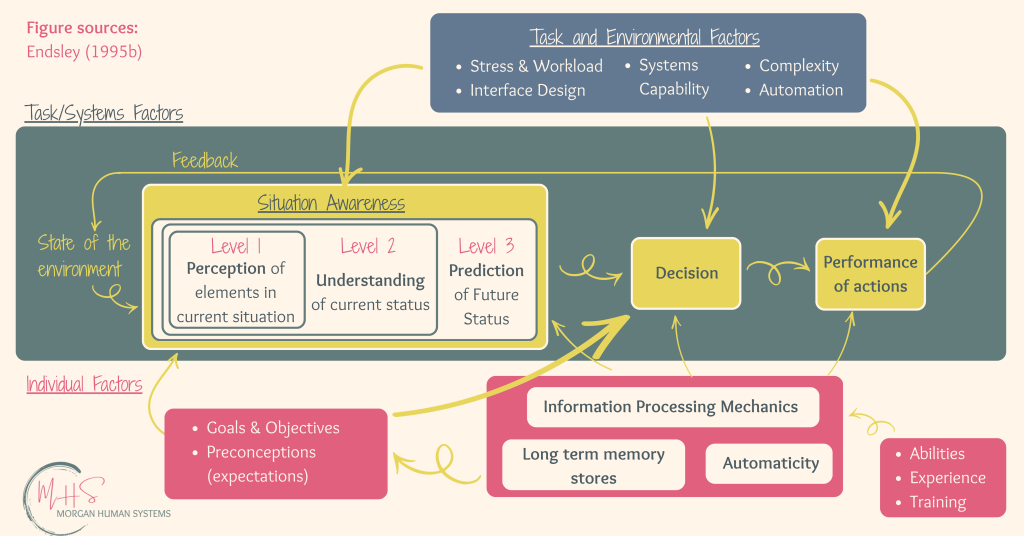
Situation awareness, as described in Endsley’s model, has three levels: perceive, understand, predict. Notice, make sense of it, anticipate what comes next.
PERCIEVE: A three-year-old approaching a busy roundabout can probably perceive the vehicles, they might even shout “bus!” but they won’t understand when it’s safe to cross, and they certainly won’t predict which vehicle is about to come off and head their way so their decision on whether to cross the road is not safe.
UNDERSTAND: An eight-year-old does a bit better, they can notice the cars and understand they shouldn’t step out in front of them, but predicting the trajectory of a car navigating a roundabout is still a stretch.
PREDICT: It’s not really until thirteen or fourteen that someone can do all three: notice the car, understand it’s indicating, and predict where it’s going in time to decide when to cross.
Same roundabout. Very different levels of situation awareness. And solvable in different ways.
Back to the report
So when you write “loss of situation awareness” as a finding (maternity colleagues I’m looking at you here because it so often gets used to beat up midwives) you need to go a level deeper. Because the response looks quite different depending on where the gap actually was.
Did they not perceive the information at all? Perhaps an abnormal CTG feature. If the information wasn’t visible, or wasn’t surfaced at the right moment, in the right place, in a way that cut through. The solution probably involves making critical information more salient: better display, better alerts, better information hierarchy.
Did they perceive it but not understand what it meant? Different problem, different action. That might point to training gaps, or more likely to a system that assumed knowledge people didn’t have, or a context where the normal cues for understanding weren’t present. The fix here is less about making things visible and more about building shared mental models.
Did they understand the information but fail to predict what it meant for what came next? This is where briefing becomes genuinely powerful. If you can share your mental model with your colleagues “if this happens, it’ll look like this, and my next concern will be X” you give people a much better chance of working with you at the right level, rather than one step behind. You’re essentially lending your prediction capacity to the team.
So, before you write “loss of SA”…Firstly, don’t. In most cases, the system didn’t give your colleague the information they needed, so it wasn’t really theirs to lose. The framing matters enormously, and “loss of situation awareness” has a habit of landing on individuals rather than on the environment, the workload, the design of the ward, or the culture that meant something didn’t get said.
And secondly, if you are going to analyse it, look one level deeper. Perceive, understand, predict. Which one? Because that’s where you’re learning and your action lives.
Thanks,
Lauren