
Hi ,
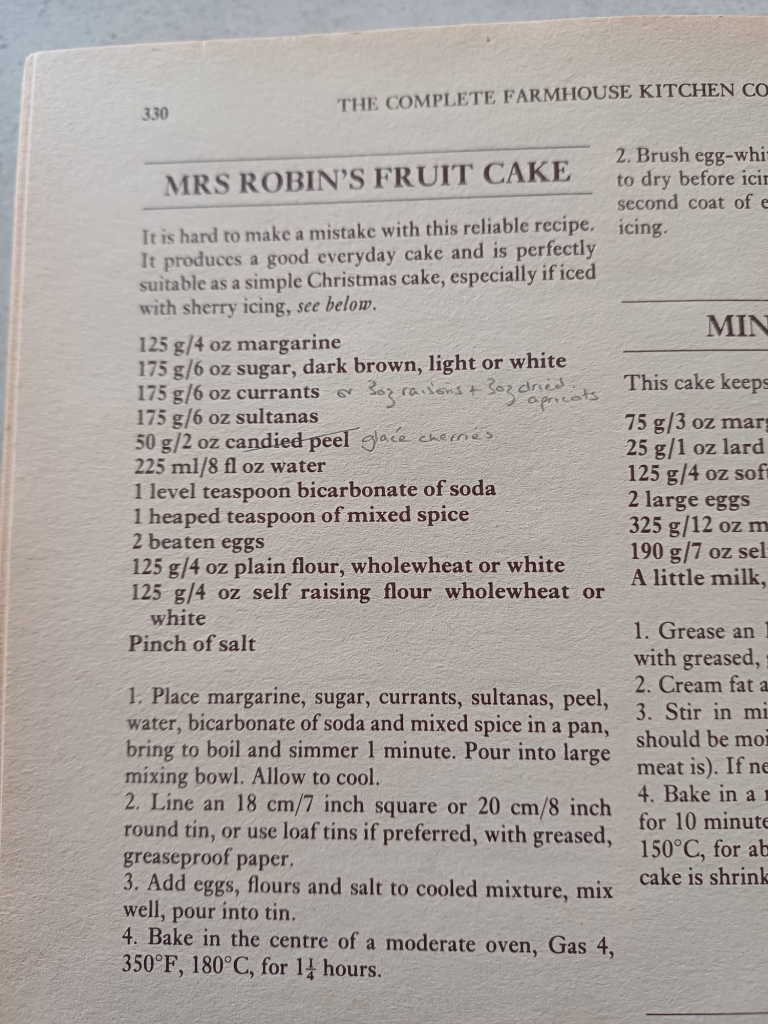
My mother-in-law makes a legendary fruit cake, it’s rich, sticky, nicely spiced and we all love it! My sister-in-law and I both asked for the recipe. She found it in the recipe book and sent us a picture:
We each had a go at baking it…ours was dry, burnt around the edges, nothing like hers! You need to “Just follow the recipe,” she said.
A couple of weeks ago, she came to visit, “make this cake with me” I asked… and that’s when it got interesting.
Within the first five minutes:
“Oh, I use all self-raising flour.” The recipe says a mix of plain and SR.
“Whisk the eggs before you add them.” It doesn’t say that!
“Turn the oven down, that’s way too hot.” The recipe says 180, she turned it down to 150.
Then an hour into cooking she tested it and took it out the oven…the recipe says 1 ¼ hrs!
Her ingredients, her method, and her cooking time were all completely different to what the recipe says. When I pointed this out, she looked genuinely puzzled. “I never actually realised, I thought I followed the recipe.”
This is a perfect illustration of the difference between three things that matter enormously in patient safety: work as prescribed, work as disclosed, and work as done.
Work as prescribed is the recipe on the page, the policy, the protocol, the SOP. Work as disclosed is what people tell you they do when you ask them, my mother-in-law’s confident “I just follow the recipe.” And work as done is what actually happens when you’re standing in the kitchen watching someone who genuinely knows what they’re doing (that’s never me – in case you haven’t already clocked that!).
The gap between these isn’t usually dishonesty or malicious, though I have considered the possibility that she wanted to protect her cake’s legendary status. It’s something much more interesting than that: it’s tacit knowledge.
Tacit knowledge is the stuff that experts carry in their hands and their instincts. It’s the slight hesitation before adding the eggs, the way the batter looks when it’s right, the knowledge that fan ovens will run hotter than when that recipe was written. It develops through years of doing, and the person who holds it often can’t fully articulate it, not because they’re being evasive, but because they’ve genuinely stopped consciously noticing it.
This is why incident investigations that rely solely on interviews and documentation can only ever give you a partial picture. People will tell you what they believe they do. They’ll be honest. They’ll be trying to help. And the account they give can still be incomplete, because the gap between what we think we do and what we actually do is often invisible to us.
The only reliable way to understand work as done is to be there while it’s being done. Structured observation, time in the area, sitting alongside people as they work. It’s slower, it takes more resource, and it is frequently the difference between finding the system factors that actually shaped the incident and writing a report that reflects the prescribed process rather than the lived reality.
My mother-in-law laughed when I told her I was going to write about this. She asked what on earth baking a cake could possibly have to do with patient safety.
Quite a lot, as it turns out.
Oh, and don’t ask me to bake it again – I still can’t get it quite right, you can talk to me about learned helplessness one day 😉
Lauren